How to Check Apartment Noise Before Buying a Flat
Check the sounds you may live with: assess the exact room, visit at the hours that matter and record what a quiet sales visit cannot establish.
In this guide
The flat was quiet when you visited. Will it be quiet when you live there?
A weekday afternoon visit can leave a reassuring impression. The windows are closed, the air conditioning is running and most of the conversation stays in the living room.
Your actual routine may be different. A bedroom could face the evening play area. A workroom might share a wall with a busy corridor. The balcony may overlook a road that fills up after office hours. These possibilities deserve a closer look before you decide.
A single quiet visit tells you what happened during that visit. Check the room, the hour and the conditions that matter to your household.
Start with the room where quiet matters most
Choose the space with the most demanding use: a bedroom for someone who works shifts, a room used for video calls, or a child's study area. Visit that room before the balcony or clubhouse distracts you.
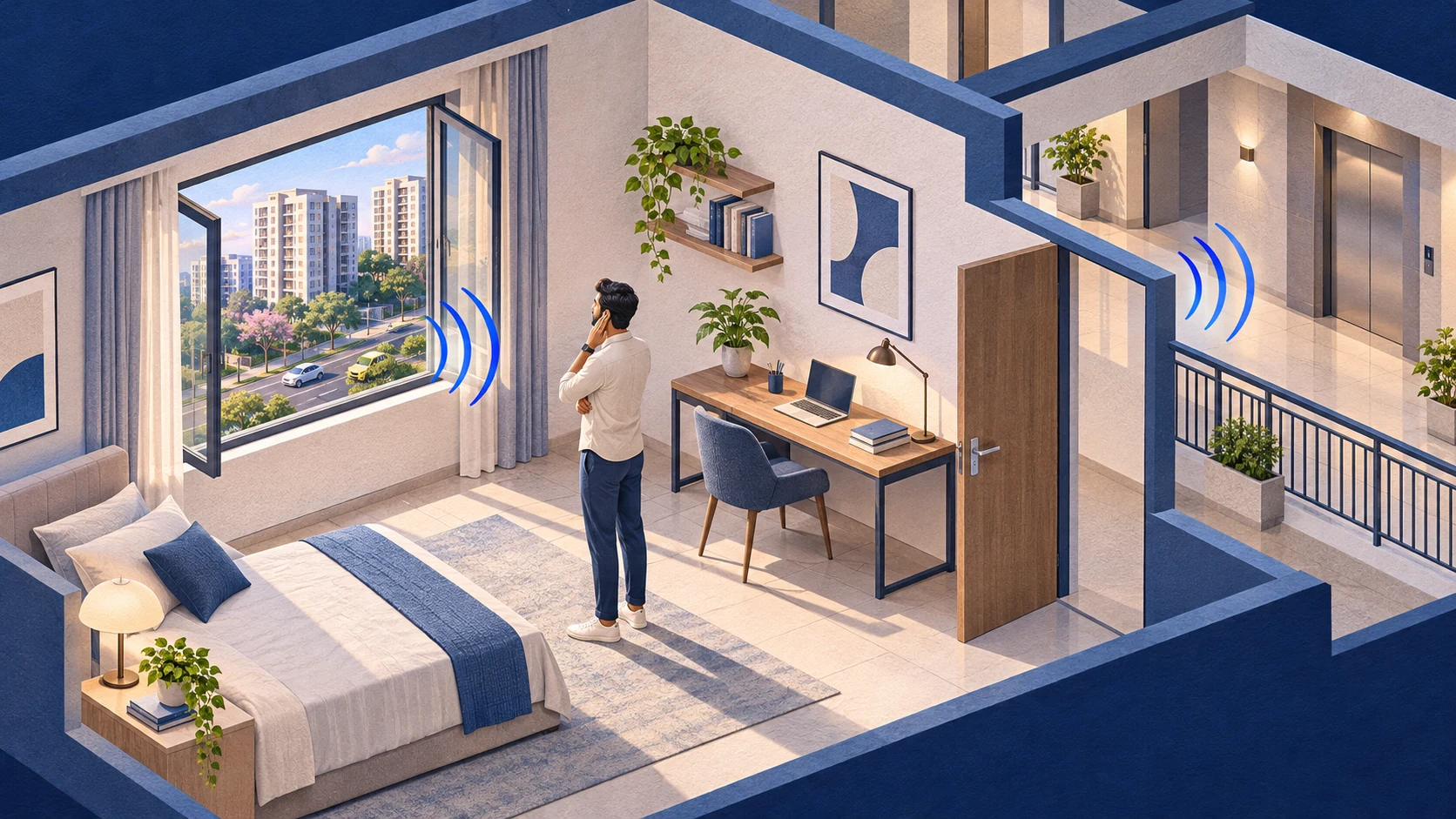
Stand where the bed, desk or chair would actually go. Listen with the room door in the position you normally use. Then check the windows both open and closed, where access and conditions allow. If the room feels acceptable only with every opening shut, consider whether that fits your preferred way of living.
Write down the activity you need to protect. “Quiet enough for calls between 10 am and 5 pm” gives you a more specific question to investigate than “low noise.”
Look for sound sources in three places
1. Beyond the project boundary
Look for traffic, commercial activity and nearby construction. Ask which room faces each possible source and when it operates. A road seen from the balcony may matter less to you than a recurring sound outside the bedroom.
2. Inside the community
Check the position of play areas, courts, drop-offs and equipment relative to the exact flat. A service area behind the tower may require a plan or a conversation with the facility team to identify.
3. Around the unit
Consider the lift lobby, corridor, services and adjacent homes. What can you hear during ordinary use? Which room shares the relevant wall or opening?
Proximity is a reason to investigate. It does not establish that a flat will be uncomfortable. Avoid assuming that a higher floor, a corner position or a particular wall material guarantees quiet.
Visit at a time that tests your concern
If evening activity worries you, arrange an evening visit. If the workroom is the priority, check it during the hours you expect to use it. A second visit is most useful when it answers a question left by the first.
Ask for normal conditions. Facility staff can explain operating hours and arrange an authorised demonstration when appropriate. There is no need to request unusual equipment tests, enter service rooms or inspect machinery yourself.
In an occupied project, ask residents specific questions with their consent. “Can you hear the court from this stack after dinner?” usually produces a more useful answer than “Is this a good project?” Treat individual accounts as additional evidence and look for consistent patterns.
Use this simple observation checklist
Record the same details for each flat so that your comparison remains useful:
- Room and purpose: bedroom for daytime sleep, workroom for calls, or the space most important to you.
- Date and time: when you visited and whether it represented your usual routine.
- Doors and windows: open, closed, or only one condition tested.
- Sound source and pattern: road traffic, court activity, corridor use; continuous, repeated or occasional.
- What remains unknown: equipment not running, an unoccupied neighbouring flat, a future construction phase or an inaccessible unit.
Example observation: “Workroom, 6.30 pm, window open: repeated vehicle horns from the approach road. Window closed: horns still audible but less intrusive.”
This describes what you observed without pretending to be a professional acoustic report. A phone sound-meter app may help you record rough differences, but device hardware, settings and conditions affect the result. NIOSH notes that sound-measurement apps may not meet regulatory requirements. Its guidance concerns workplaces; occupational exposure limits should not be used as a bedroom comfort score. Read the NIOSH guidance on measurement limitations.
If acoustic performance is central to your purchase, ask an appropriately qualified specialist to assess the relevant conditions. A precise-looking number on a phone is not enough to establish sound insulation or compliance.
Separate a window claim from whole-room performance
If the sales team mentions acoustic glazing or a quieter window system, ask what is actually specified for the offered flat. Request the product or system description, where it will be installed and what supporting test information is available.
A claim about one component does not establish the performance of the completed room. Installation, seals, doors, vents and other sound paths can matter. Ask how a performance statement relates to the installed arrangement.
Also consider everyday use. Closing a window may reduce an outside sound, but you may want that window open for part of the day. Assess the room in the conditions you intend to use.
Two flats, two different questions
Imagine two fictional flats at the same price:
- Flat A: a shorter walk from the lift, with a bedroom facing an internal court.
- Flat B: farther along the corridor, with a bedroom facing a less active edge of the site.
A buyer who needs daytime sleep would investigate the court's actual use before preferring A. A household that values the shorter walk may accept some activity if the bedroom remains suitable at its usual sleeping hours. Neither the distance from the lift nor the bedroom direction decides the answer alone.
Buying under construction? Keep the unknowns visible
Record which observations are unavailable. Review the exact stack, equipment positions and planned shared areas. Keep future occupied conditions as an uncertainty: a model flat in a different location cannot resolve how the offered home will sound.
Leave with a decision you can explain
Before shortlisting, answer four questions:
- Which room needs the most quiet, and at what time?
- Which sources did you observe, and which were only suggested by a plan?
- What changes when doors and windows are used normally?
- What evidence is still missing for the exact flat?
Your next step may be to proceed, revisit at another hour or request a specialist assessment. The aim is to understand the sound-related compromise before it becomes part of your daily routine.
Use this alongside PropSensy's apartment site-visit checklist and guide to choosing the best flat within a project. For the wider approach, read what PropSensy does.
Sources and illustration note
NIOSH: Understand Noise Exposure supports the limited point about measurement tools and app limitations. Workplace exposure thresholds are not applied to home comfort. Checked 3 November 2026.
The cover is an AI-generated illustration of a fictional apartment, not an actual property or an acoustic assessment. The two-flat example is hypothetical. This guide supports buyer questions and observations; it does not certify acoustic performance.